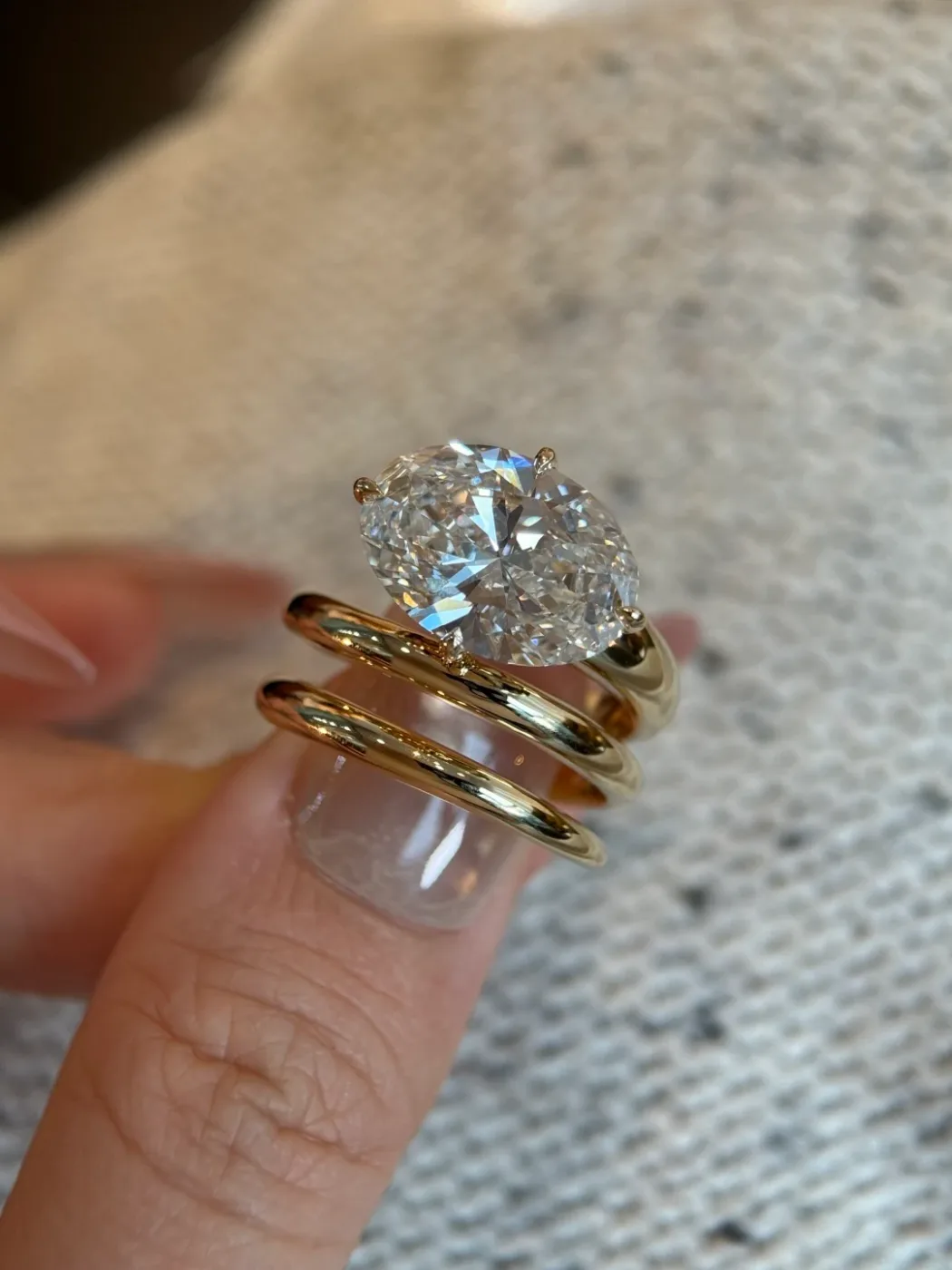
To match a wedding band to an engagement ring, check the setting from the side before choosing a band. A straight band sits close only if it clears the centre setting; a contoured band follows a low or projecting setting. A visible gap is fine if intentional. Choose the metal, width and finish together, ideally while designing both rings.
The design guidance and external sources below were checked on 1 October 2026. Whether you are choosing an engagement and wedding ring set in Australia or adding a band to a ring you own, start with the fit. Two rings can look well matched in separate photographs and meet quite differently on a finger.
Does the wedding band need to sit flush?
No. “Flush” means the wedding band can sit against the engagement ring without a visible space at the front. It is one possible look, not a requirement for a successful pair. A slim line of skin between the rings can make each outline easier to see.
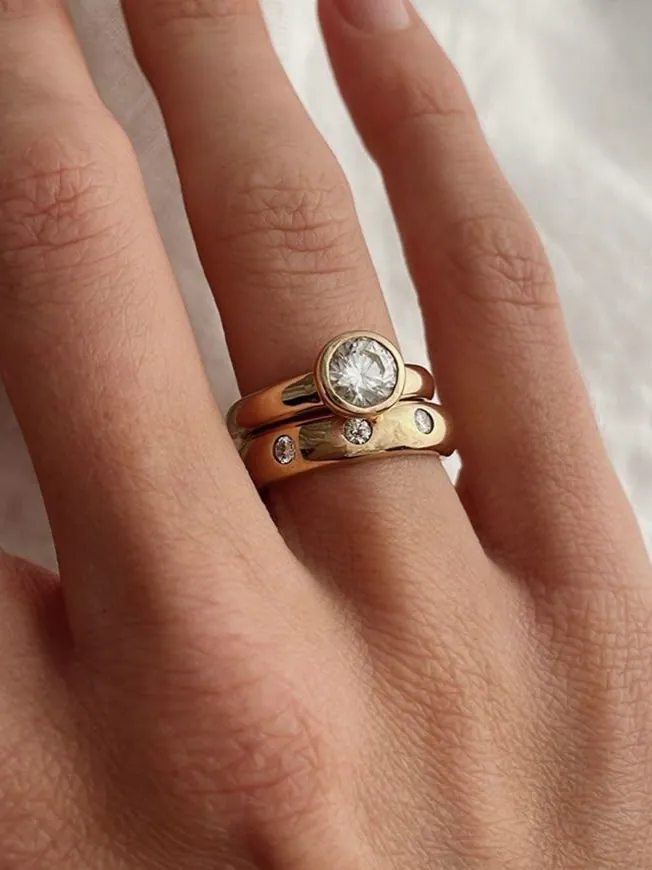
The question is whether the gap looks deliberate and whether the rings sit comfortably. In the photograph above, an oval centre ring is worn beside a band of larger round stones. The space between them is visible. That tells you more about the pair than a product photo of either ring alone, though a photograph cannot tell you where the settings touch as the rings move.
Look at a proposed pair in three ways: from above, from the side and on the hand with the fingers relaxed. From above, you can judge the outline. From the side, you can see whether a band is stopped by the head of the engagement ring, the part that holds its centre stone. On the hand, you can judge the combined width and whether the rings feel comfortable.
A close fit also deserves a contact check. GIA notes that stacked rings can scratch and wear one another, particularly when different metals are involved (GIA ring stacking guide, checked 1 October 2026). Ask a jeweller to check the actual points of contact, especially beside prongs or small stones. A photograph showing no gap cannot answer that question.
When will a straight wedding band fit?
A straight band is the simplest starting point if there is enough clearance beneath the engagement ring’s centre setting. The band can then sit beside the shank without being stopped by the head. “High-set” does not guarantee a flush fit on its own; the shape and position of the whole setting matter.
The Casting House design guide, checked 1 October 2026, illustrates this distinction. It shows a straight band sitting flush when the engagement ring has space beneath its head. It also shows a projecting gallery head holding a straight band away. That side-view test is more useful than judging the height of the centre stone from above.
A straight band gives you options when you wear it alone. Its outline does not depend on the engagement ring being next to it. If you expect to leave your engagement ring at home during some activities, picture the wedding band by itself as well as in the pair. GIA notes that some people wear only their wedding band day to day (GIA guide to wearing both rings, checked 1 October 2026).
A straight band may also be the right choice when it leaves a gap. Before asking to close that space, decide whether you actually dislike it. Making an engagement-ring setting higher solely to accommodate a flush band changes how the engagement ring sits on your hand. Ask to compare both profiles before settling the design.
When does a contoured band make sense?
Choose a contoured band when you want the wedding band to follow a setting that interrupts the straight line. A contour may be a shallow curve around the centre, or a more pronounced shape that accommodates a projecting head. You may also hear it called a curved or shadow band. The Casting House guide shows a shadow band shaped to sit beside a large gallery head (design guide, checked 1 October 2026).
The curve should be drawn for the particular engagement ring. “Oval”, “pear” or “halo” describes what you see from above; it does not specify the height, underside or position of the setting. Two oval rings can therefore need different bands. If a product listing says a band fits all oval engagement rings, ask to see how it fits your ring’s side profile.
A contour can make the two rings read as one design when worn together. Try viewing the proposed band alone, too. A deep curve may look conspicuous without its partner, while a gentle curve may be easy to wear either way. Neither result is inherently better. The choice depends on how often you expect to wear the wedding band by itself.
Do not assume the deepest possible curve gives the best pair. Check where its shoulders meet the engagement ring and whether any stones or prongs face one another. The aim is a shape you like at normal viewing distance and a fit a jeweller can assess in person or from accurate dimensions.
Is a gap between the rings a problem?
A gap is an appearance choice unless it comes with an unwanted fit or contact problem. A straight band beside a low centre setting may leave a crescent of space. That can frame the engagement ring nicely, particularly when the wedding band has its own distinctive stones or texture.
What looks like a neat gap in a fixed photograph may change as separate rings rotate. Ask how the pair looks when your hand is relaxed and when the bands shift slightly. If one ring repeatedly turns to a position you dislike, discuss sizing and the shape of the bands rather than judging only a carefully arranged image. GIA advises having rings professionally sized and notes that stacking multiple rings can affect how tight they feel (ring stacking guide, checked 1 October 2026).
A gap should not be used to guess that the settings are safely separated throughout wear. The engagement ring’s head may extend farther at one point than it appears to from above. Equally, closing the visible gap does not prove that the rings touch in a harmless place. Ask the jeweller to identify what meets what.
If you like a straight band for wearing alone and a gap when the rings are together, keep it. There is no need to order a contour simply because matching sets are often photographed flush.
How closely should the metals and finishes match?
Match the actual metal and finish if you want the rings to appear as one set. “Yellow gold” alone will not guarantee the same shade, and “white gold” will not tell you what the finished surfaces will look like after wear. Compare physical samples or a proposed pair in consistent light when you can.
At ENBOM DIAMONDS, 18ct gold is standard and 14ct gold is available on request. If you are choosing between them, the 18ct and 14ct gold guide explains the difference. For a close colour match, specify the metal for both new rings in the same design brief rather than relying on two screen images.
White gold needs particular attention. GIA explains that white gold is often rhodium plated for a whiter appearance and that the plating can wear away over time (GIA gold guide, checked 1 October 2026). Two white-gold rings may match when new yet show different tones later if their alloys or finishes differ. Ask what alloy and finish are proposed for each ring.
You can also choose contrast deliberately. Yellow and white metals do not have to look identical to make a considered pair. GIA shows mixed-metal stacks and advises attention to wear where rings of different metals sit together (GIA ring stacking guide, checked 1 October 2026). If you want a mixed-metal set, have its contact points checked; colour preference alone cannot settle how the pair will wear.
What else should match besides the metal?
Compare width, outer shape and the position of any small stones. A wedding band can sit neatly beside an engagement ring and still feel too wide as a pair. Conversely, a very fine band may look slight beside a broad engagement-ring shank. View both rings at the scale of a hand, not only in close-up photographs.
The outer profile changes the look even when two bands have the same width. A softly rounded band beside a flat-edged shank creates a visible change of line. Repeating an edge shape can make separate rings feel related without using identical stones. These are visual decisions, so ask for a view of the pair rather than assuming that matching measurements will produce the same effect.
If the wedding band will carry stones, check how far the settings extend towards the engagement ring. Small stones can change the band’s edge and its points of contact. GIA recommends regular professional inspection of worn rings because prongs can loosen over time (guide to wearing engagement and wedding rings, checked 1 October 2026). A design that looks close in a rendering still needs its settings assessed for wear.
Finally, think about your usual arrangement. Will you wear both rings every day, alternate between them or add another band later? That answer affects how much you may value a wedding band that stands on its own. It is easier to settle before choosing a deep contour or a broad stone-set band.
Should you plan the wedding band when you order the engagement ring?
Yes, if you already know you want to wear the rings together. You do not have to decide every decorative detail at once. Decide whether you prefer a flush pair, a deliberate gap or a wedding band that works especially well alone. The engagement-ring setting can then be assessed with that preference in mind.
For a new custom ring, I would start the brief with these questions:
| Decision | What to check |
|---|---|
| Fit | Should the rings meet at the front, or is a visible gap welcome? |
| Setting | Does a straight band clear the engagement ring’s head in the side view? |
| Wedding band alone | Do you like its outline without the engagement ring? |
| Contact | Where will metal, prongs and any small stones meet? |
| Appearance | Do you want the same metal and finish, or a deliberate contrast? |
Send reference photographs of pairs you like, including a side view where possible. ENBOM DIAMONDS makes new jewellery from a photo or idea, subject to what can be made. The guide to starting a custom ring from a Pinterest photo explains why a reference is a starting point rather than a complete specification.
Planning both rings together can expose a choice that would otherwise appear later: a low setting you love may produce a gap with a straight band. You can keep the low setting and accept the gap, consider a contour, or review a different engagement-ring profile. None of those choices should be made by looking at the centre stone alone.
If a proposal or wedding date is fixed, raise it with the first enquiry. The custom engagement-ring timeline explains the usual order-to-delivery period in Australia and why design decisions belong early in the process.
What if you already own the engagement ring?
Use the ring you own as the specification for the new band. Photograph it from above, from both sides and on your hand. Include its ring size if you know it, and say whether you want the wedding band to sit flush or whether you like a gap. Measurements taken from the actual ring will be more useful than its stone-shape name alone.
An in-person check by a jeweller is valuable if you are unsure where a proposed band will touch an existing setting. That matters particularly when prongs, a halo or stones along either band are close to the neighbouring ring. GIA notes that stacked rings can increase scratches and wear (ring stacking guide, checked 1 October 2026).
ENBOM DIAMONDS makes new pieces from a reference; we do not remodel existing jewellery. If you want a new band to accompany an engagement ring you already own, send clear photographs and tell me what you want the pair to look like. The existing ring itself would remain as it is.
Do oval and pear rings need a special band?
Neither shape dictates one wedding-band style. The setting beneath an oval or pear centre determines whether a straight band can sit close. A low basket, projecting gallery or other detail may stop the band before it reaches the engagement-ring shank. The side view answers that question better than the stone’s outline.
For an oval design, look at how the wedding band approaches the centre from each shoulder. A curve can echo the oval, but a straight band with space around the centre may be the look you prefer. For a pear design, check the orientation of its point and the setting around it before choosing a symmetrical contour. The band should be designed for that ring, not for the label “pear”.
If you are still choosing the engagement ring, explore the oval and pear design pages, then ask how your preferred setting would work beside a wedding band. The broader custom engagement rings page is the starting point for a new design.
Where won’t this article help you?
A guide cannot confirm the fit of two particular rings from a face-on photograph. It cannot measure the clearance beneath an existing setting, assess wear at its prongs or tell you how the pair will feel on your finger. For those decisions, the actual rings, accurate dimensions or a design that shows both profiles are needed.
This article also does not tell you whether an older ring is sound enough for everyday stacking. If its stones move, its prongs look worn or its shape has changed, have a jeweller inspect it before ordering a band to fit tightly around it. GIA recommends professional checks because settings can loosen with wear (guide to wearing both rings, checked 1 October 2026).
Send me your engagement-ring reference and the way you want to wear the pair. Explore a custom engagement ring or message me on WhatsApp.
Questions
Does a wedding band have to sit flush against an engagement ring?
No. A visible gap can be a deliberate part of the design. What matters is whether you like the pair on your hand and whether the band presses against the setting or its stones. Check the rings together from above and from the side.
Will a straight wedding band fit a low-set engagement ring?
It may sit beside the ring with a gap if the centre setting projects beyond the shank. A straight band can sit flush only when there is enough space beneath the setting. Ask to see the two profiles together before ordering.
Should my wedding band be the same metal as my engagement ring?
The metals do not have to match in colour. If you want a close colour match, compare the actual alloys and finishes rather than relying on a photograph. Different metals worn together may also wear differently, so ask a jeweller to check where the rings touch.
Is it better to design the wedding band with the engagement ring?
If you are ordering a new engagement ring, decide how you want to wear its wedding band before the engagement-ring design is final. Both profiles can then be considered together. You can still choose a band later, but you will be working around the engagement ring's existing setting.
Sources
- Design Guide: Rings & Bands | Casting House Checked 1 October 2026
- Ring Stacking Guide: How to Style and Stack Your Rings | GIA 4Cs Checked 1 October 2026
- How to Wear Your Engagement Ring and Wedding Band | GIA 4Cs Checked 1 October 2026
- Guide to White, Yellow, and Rose Gold Engagement Rings | GIA 4Cs Checked 1 October 2026