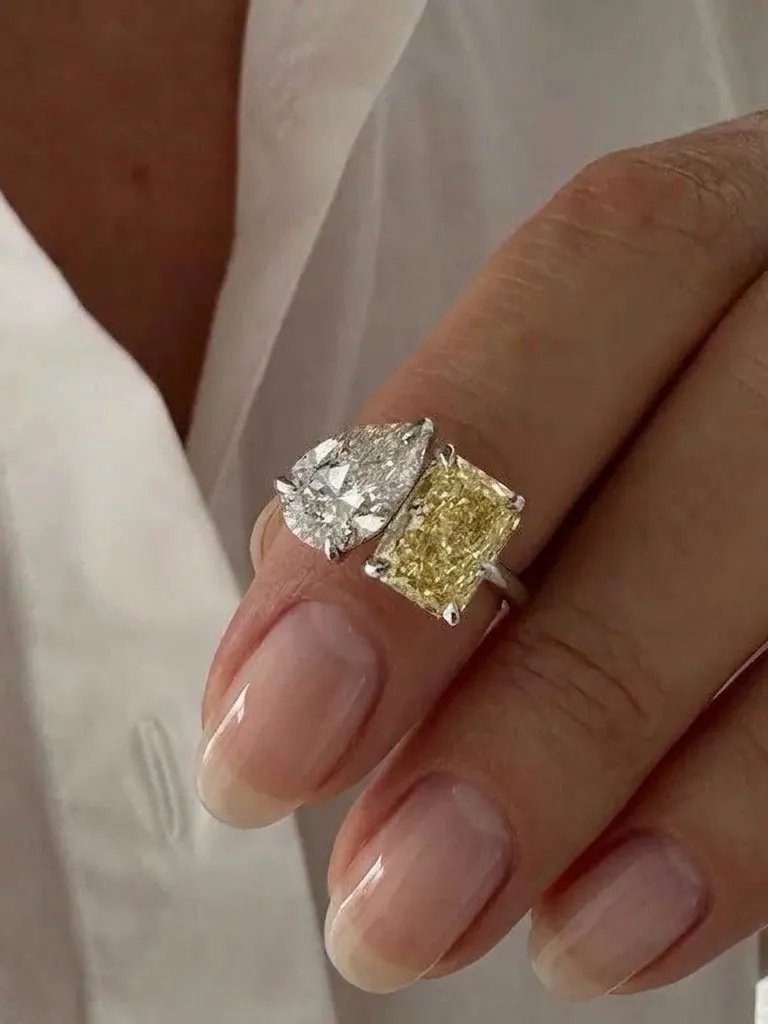
Carat measures weight, not width. A deep-cut 1-carat round can measure about 6.0 mm across, while a well-cut one can reach about 6.5 mm. The wider outline has roughly 17% more visible area although both weigh the same. Carat Diamonds and Rare Carat give those approximate diameters; GIA explains the hidden weight (all checked 28 September 2026).
What does diamond spread mean?
Spread is the space a stone takes up when you look straight down at it. For a round diamond, the useful measurement is its diameter at the girdle, the narrow edge around its widest part. Carat tells you how much the whole stone weighs, including the portion below that edge. One carat equals 0.20 grams, according to GIA (checked 28 September 2026).
The difference is easiest to see with two circles. Rare Carat gives roughly 6.5 mm as the diameter of a well-cut 1-carat round, while Carat Diamonds says a poorly cut one may measure 6.0 mm or less (both checked 28 September 2026). Using 6.0 mm and 6.5 mm as an illustration:
| Approximate diameter | Circular outline area, calculated as π × (diameter ÷ 2)² |
|---|---|
| 6.0 mm | 28.3 mm² |
| 6.5 mm | 33.2 mm² |
The arithmetic is (6.5 ÷ 6.0)² ≈ 1.17. The 6.5 mm outline covers about 17% more area than the 6.0 mm outline. That supports saying the face-up area can differ by almost 20%. It does not mean every pair of 1-carat stones differs that much, or that a 17% area difference looks exactly 17% larger to your eye. Brightness, outline and setting affect what you notice.
Spread also has a limit: a cutter can make a stone wider by cutting it too shallow. It might measure generously and still look dull. I would check the measurements and the cut together.
How do depth and table percentages affect size?
Depth percentage describes a round diamond’s height from its flat top to its bottom point, divided by its average girdle diameter. Table percentage describes the width of that flat top as a share of the same diameter. Neither percentage is the face-up diameter. GIA’s round-brilliant anatomy guide gives both formulas (checked 28 September 2026).
A deep pavilion, the lower part of the stone, can hold weight that adds little to the view from above. A thick girdle can do the same. GIA notes that a poorly cut 1.20-carat round can appear the same size as a well-cut 1.00-carat round because some of its weight is hidden (GIA, checked 28 September 2026). The opposite shortcut has a cost too: make the pavilion too shallow and light may escape rather than return through the top (GIA, checked 28 September 2026).
For a GIA-graded round, a table between 52% and 62% and total depth between 57.5% and 63.0% can fall within its Excellent cut grade. Those are limits for individual measurements, not a recipe. GIA’s cut-grade chart says the table, crown angle and pavilion angle must work together; measurements inside the limits can still produce a lower grade. The same chart includes a 68.2%-deep Fair example whose steep angles hurt its appearance (checked 28 September 2026).
That is why I would be wary of a seller who points to one favourable percentage and stops there. Ask to see the diameter and the overall cut assessment, then look at the stone away from bright display lighting.
What should a 1-carat round measure in millimetres?
About 6.5 mm is a useful reference for a well-cut 1-carat round, not a size every 1-carat round must meet. Rare Carat’s carat guide gives that approximate diameter; Carat Diamonds gives around 6.0 mm for a poorly cut round with weight hidden in its depth (both checked 28 September 2026). Half a millimetre sounds small until you compare the circles side by side.
A report gives the measurements of the particular stone, usually as a minimum diameter, maximum diameter and depth for a round. Take the average of the first two numbers when you want a single diameter for a rough area comparison. Keep both numbers in view as well: a round with noticeably different minimum and maximum diameters is not as round as one number might suggest. GIA records both because even well-cut rounds are not perfectly circular (GIA, checked 28 September 2026).
Millimetres are more useful than a photograph for comparing size. Photos can be cropped or enlarged, and a wide ring setting changes the impression of the centre stone. The report measurement lets you compare two loose stones on the same scale. The stone and size guide can help you picture that scale on a hand before you choose a shape.
Why can an oval, pear, marquise or emerald cut look larger?
An elongated outline gives a stone more length across the finger than a round of the same weight. GIA’s shape guide says oval, pear and marquise shapes can appear larger for that reason (checked 28 September 2026). That is an impression of size, not a promise that every elongated stone has more face-up area than every round.
Compare length and width. A long, narrow oval may catch your eye from a distance while covering less width than you expected. An emerald cut has a rectangular outline and broad, step-like facets, so its long measurement alone says even less about how large or bright the whole stone will look. For an oval, GIA describes length-to-width ratios around 1.30:1 to 1.50:1 as common choices with different appearances (GIA oval guide, checked 28 September 2026). The ratio describes shape; it does not replace the actual millimetres.
Oval and pear stones can also show a bow-tie: a dark pattern across the centre. Some contrast is normal, but a broad, dark patch that stays put as the stone moves can take attention away from its generous outline. GIA’s oval guide and pear guide recommend looking at the stone from different angles and in ordinary light (both checked 28 September 2026). For an elongated shape, I would choose a slightly shorter stone that looks lively over a longer one with a distracting centre.
Where do you find spread and cut on a grading report?
Start with the measurements in millimetres, then read the depth and table percentages. For a round, check the cut grade where the report provides one. GIA documents a stone’s weight and dimensions, plus its cut grade when applicable (GIA, checked 28 September 2026). GIA assigns an overall cut grade to standard round brilliants; its oval reports instead give information such as polish and symmetry without an overall cut grade (GIA oval guide, checked 28 September 2026).
Read the report in this order when comparing two 1-carat rounds:
- Check that both weights really are 1.00 carat.
- Compare the minimum and maximum diameters. Those numbers tell you what will face up.
- Look at depth percentage and girdle thickness for weight that may be hidden.
- Read the cut grade and look at both stones. The measurements cannot show every difference in light and pattern.
For an oval, pear, marquise or emerald cut, compare both length and width, then look at the outline and the stone in motion. A single depth percentage cannot tell you whether a bow-tie is distracting. The IGI and GIA guide explains which reports apply to different stones, and how to check an IGI report covers matching the paperwork to a specific lab-grown diamond.
At ENBOM DIAMONDS, a centre stone of 0.30 carat or more comes with its laboratory report included in the price. Smaller, side and pavé stones are not individually reported. Most stones I set are lab-grown diamonds graded by IGI; natural diamonds are available by request with GIA reports. I pick the stone myself, so the report measurements are part of what I compare before the piece is made.
What would I choose between two stones of the same weight?
I would pay attention to cut before paying for a higher carat figure that disappears into depth. With two 1-carat rounds, I want to know their diameters and see how they handle light. A 6.5 mm outline has an advantage over a 6.0 mm outline on paper, but a measurement cannot tell me whether I like the stone once it moves.
I choose stones in person in Shenzhen because video makes quality hard to judge. I look at the proportions and the finished work of the workshop that will set the stone. When I check a piece, I look under a loupe at the setting and the places where metal and stones meet. Those checks matter alongside the numbers on a report.
Before paying any seller, I would ask for an independent laboratory report and the exact cut details. I would also ask what an extra charge buys me. Bright shop lights can make it hard to see the difference between two stones. An independent report gives you measurements to compare when the lights are off.
Where does this size comparison stop helping?
The 6.0 mm versus 6.5 mm calculation is for two round diamonds. It says nothing by itself about colour, clarity or whether one stone looks better in your chosen setting. Those questions need the individual stone and its report. A larger circular outline can still be the less appealing choice if its cut produces weak light return.
The same basic geometry applies to coloured gemstones, but diamond size charts do not transfer directly to them. GIA gives diamond a specific gravity of 3.52 and ruby 4.0: at one carat, the denser ruby has less volume (GIA, checked 28 September 2026). Colour also changes cutting decisions. GIA’s coloured-stone discussion explains how a cutter may accept a different depth to improve face-up colour or avoid a pale area called a window (checked 28 September 2026).
If you are choosing between two stones, use the stone and size guide to settle on an outline, then send me the reports or links. I can compare their actual millimetre measurements and cut with you before you decide which one belongs in your piece.
Questions
What size is a 1-carat round diamond in mm?
A well-cut 1-carat round is usually about 6.5 mm across, but that is a reference size, not a rule for every stone. A deep-cut round of the same weight can be closer to 6.0 mm. Ask for the measurements of the stone you are considering, rather than relying on its carat weight alone. Sources: Rare Carat and Carat Diamonds, checked 28 September 2026.
Does a deeper cut make a diamond look smaller?
It can. If more of a round diamond's weight sits below its widest point, less width may be visible from above. Depth percentage helps you spot that possibility, but it cannot judge the cut by itself. GIA assesses the proportions together because the angles also affect how the stone handles light (checked 28 September 2026).
Do oval diamonds look bigger than round ones?
An oval can look longer on the finger than a round of the same carat weight, which often gives it a larger appearance. Length alone does not tell you its visible area or how bright it looks. Check both millimetre measurements and look for a distracting dark bow-tie across the centre. Source: GIA, checked 28 September 2026.
Sources
- GIA: Nine Things About Diamond Carat Weight You Need to Know Checked 28 September 2026
- Rare Carat: Diamond Carat Guide Checked 28 September 2026
- Carat Diamonds: 4 Prong vs 6 Prong: Which Makes a Diamond Look Bigger? Checked 28 September 2026
- GIA: Diamond Cut: Anatomy of a Round Brilliant Checked 28 September 2026
- GIA: Diamond Anatomy, Explained Checked 28 September 2026
- GIA: Estimating a Cut Grade Using the GIA Diamond Cut Grading System Checked 28 September 2026
- GIA: Guide to Diamond Engagement Ring Shapes Checked 28 September 2026
- GIA: Oval Cut Diamond Buying Guide Checked 28 September 2026
- GIA: Pear Shaped Diamond: Tips for Picking the Perfect One Checked 28 September 2026
- GIA: Understanding Carat Weight Checked 28 September 2026
- GIA: Colored Stone Darkness & Brightness Checked 28 September 2026