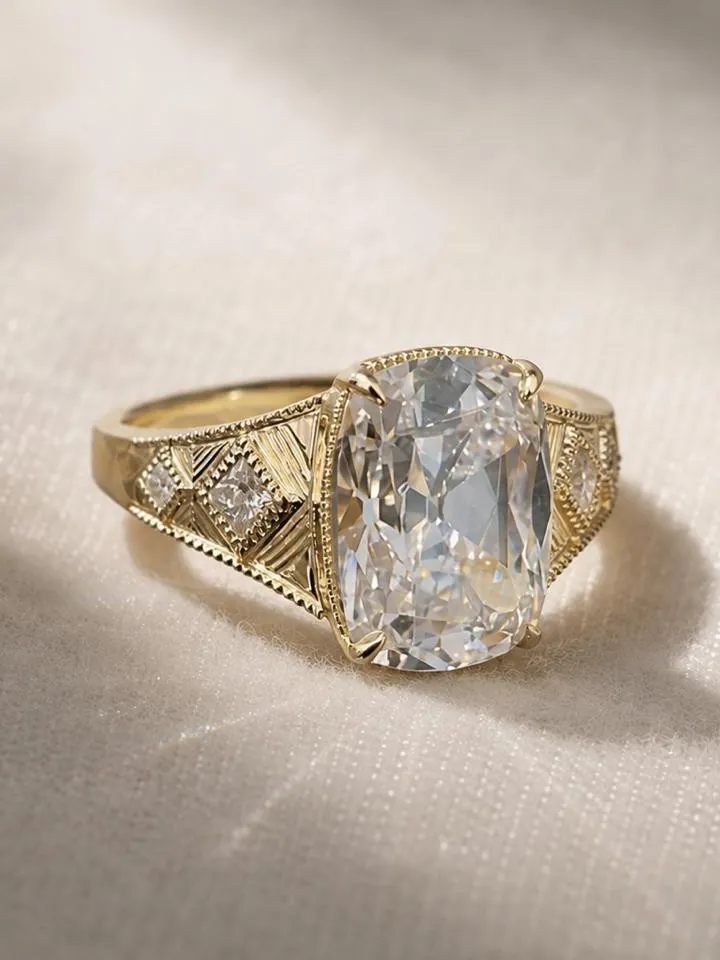
For an IGI certificate check, enter the report number on IGI’s official verification page. Compare the online record with the report you were given, line by line. Then match its number to the laser inscription on the stone’s girdle under a 10× loupe. If the three disagree, don’t pay until the difference is resolved.
Most people call the document a certificate; IGI calls it a grading report. The distinction that matters when you buy is between checking that a report exists and checking that it belongs to the stone in front of you.
Where do you find the IGI report number?
Start with the number printed on the IGI report. Ask the seller to give you that number before you pay, along with a copy of the report. If your quote or invoice identifies a particular reported stone, compare its number there too. A number on a sales document should lead back to the same IGI record, not merely to a stone with similar grades.
The third place is the stone itself. IGI puts a microscopic inscription on the girdle, the narrow edge around its widest point. IGI says that laboratory-grown stones for which it issues a report carry an LG prefix ahead of the report number on the girdle. Look for the inscription recorded on your particular report rather than guessing what it should say (IGI, checked 28 September 2026).
If the seller sends a screenshot of a report lookup, use the number to open the record yourself through IGI. A screenshot tells you what someone chose to show you; it does not let you compare the current IGI record with the document and stone yourself.
How do you check the report online?
Open igi.org/verify-your-report yourself and enter the number from the report. IGI says its digital grading report becomes available through its Verify Your Report service after the stone and report leave the laboratory. IGI’s report pages also offer a number lookup for viewing a digital copy (IGI, checked 28 September 2026).
Read the result against the copy you received. Start with the report number and whether IGI describes the stone as laboratory-grown or natural. Then compare its shape and cutting style, measurements in millimetres, carat weight, colour and clarity. Read the comments and any listed inscription. IGI identifies these as report details; some reports also have a proportions diagram or a map of clarity characteristics (IGI, checked 28 September 2026).
Do this before comparing prices. A one-character difference in a report number, or a different measurement for an otherwise similar stone, is a reason to stop and ask which stone the seller is offering. A genuine online record can be shown alongside a different stone. The lookup verifies the report data; matching the inscription is the next check.
Can an IGI report be fake, and how do you download its PDF?
A seller can show you an altered copy of an IGI report or a genuine report that belongs to another stone. Enter the number yourself on IGI’s Verify Your Report page, then compare the digital record with the seller’s copy and the stone. A matching lookup is an essential check, but it cannot by itself identify the stone in your ring.
IGI says it posts a digital report after the stone and report leave its laboratory (IGI, checked 1 October 2026). Open the result for your report number. Where the result offers Download PDF, use that control to save IGI’s copy, then compare its number, laboratory-grown or natural description, measurements, grades and any listed inscription with the document you received. An IGI report result showing the Download PDF control was accessible when checked on 1 October 2026; the control may differ between report pages. If you cannot obtain a PDF, ask the seller for the report number and check IGI’s digital record directly.
The remaining question is whether that report belongs to the stone. Ask to have the girdle inscription read under magnification and compare the whole number. Even an inscription is not conclusive: IGI documented a laboratory-grown stone carrying a natural stone’s report number (checked 1 October 2026). If the origin or identity remains in doubt, ask for independent laboratory examination before paying.
Which report fields should match?
Use the IGI record as the reference and compare each field with the seller’s report and description. This is a buying check, not an attempt to grade a stone by eye.
| Field on the report | What to compare | Red flag |
|---|---|---|
| Report number | The number on your copy, IGI’s online record, the sales document if it names a reported stone, and the girdle inscription | One digit or prefix differs |
| Description or origin | “Laboratory-grown” or “natural” in the IGI record and in what the seller told you | A stone offered as lab-grown has a natural-stone report, or the reverse |
| Shape and cutting style | The report, quote and stone shown to you | The shapes differ, even if the carat weights match |
| Measurements | The millimetre dimensions on your copy and IGI’s record | The two records give different dimensions |
| Carat weight | The report, online record and quoted stone | The weight on the quote belongs to another report |
| Colour, clarity and cut details | The exact grades stated online and in the seller’s paperwork | A quoted grade is higher than the grade IGI recorded |
| Comments and inscription | Any inscription or other detail recorded for that stone | The inscription you can read does not match the one recorded |
Carat weight alone is a poor identity check. Two stones can weigh the same and have different measurements, grades or cutting styles. If you’re comparing how large stones look from above, the guide to why two 1-carat diamonds can look different sizes explains why the measurements deserve attention.
How do you check the laser inscription?
Ask to see the girdle through a 10× jeweller’s loupe or a microscope, and compare the full inscription with the report. GIA describes 10× magnification as sufficient to view a microscopic girdle inscription; IGI says adding its report number to the girdle allows the stone to be identified under magnification (GIA and IGI, checked 28 September 2026).
For an IGI-reported laboratory-grown stone, check the LG prefix as well as the digits. Do not stop at seeing some tiny writing on the edge. Read enough of it to establish that it is the inscription listed for the report you checked online.
A mounted stone may be harder to inspect because part of the girdle sits behind the setting’s claws or metal edge. If you cannot find the inscription yourself, ask a jeweller to locate and read it. An inscription that is difficult to see calls for a closer inspection; it is not, by itself, proof that the stone lacks one. If the seller cannot show you the number, leave the identity check open rather than treating the online report as verification of the stone.
What should make you pause before paying?
A report number that IGI cannot find needs an explanation. So does a record whose origin, measurements or grades differ from the document you received. Check for a typing error first, including a missing LG prefix. If the records still differ, ask the seller to identify the exact stone and report before money changes hands.
A seller-issued “certificate” cannot replace an independent IGI report. It may describe what the seller claims to be offering, but you cannot use it to check IGI’s grading record. Ask which laboratory examined the centre stone and for its report number. If the answer changes during the conversation, keep the purchase on hold.
Even a matching inscription has a limit. In a case IGI published in 2024, its laboratory examined a laboratory-grown stone carrying a number that corresponded to a natural diamond’s report. The stone’s main characteristics were close to the online record, but laboratory testing exposed the mismatch (IGI, checked 28 September 2026). The practical lesson is to use all three checks together and seek independent examination if a stone’s identity remains in doubt. A report lookup or a number seen through a loupe is not a substitute for laboratory testing.
What reports come with ENBOM DIAMONDS jewellery?
ENBOM DIAMONDS uses IGI reports for laboratory-grown stones and GIA reports for natural stones. A centre stone of 0.30 carat or more comes with its report included in the price. Smaller centre stones, side stones and pavé stones are not individually reported. Ask which stone the report covers when you review a piece with several stones.
Most of the stones I set are laboratory-grown. I choose the stone for each piece myself in Shenzhen, where I can see it in person rather than judging it only on video. Before you pay, you can ask for the exact stone’s report details alongside the quote. The report lets you check the stated grades and origin; you can also ask how its girdle inscription will be checked against the finished piece.
I would ask about the exact cut as well. A report states the measurements and cutting details, which tell you more than a carat figure alone. For help deciding what the grades mean when comparing stones, read IGI or GIA for laboratory-grown diamonds.
Where does this check stop helping?
An IGI report check does not verify a GIA report. If the stone comes with GIA paperwork, use GIA Report Check instead. GIA says its service compares the information on a report with the information in its database (GIA, checked 28 September 2026).
A grading report is also not a valuation. IGI says its report records a stone’s characteristics rather than appraising its value (IGI, checked 28 September 2026). If you need a valuation for insurance, ask a valuer for that separate service; the IGI lookup cannot give you a replacement value.
Before paying for a reported stone, ask for its report number, check IGI’s record yourself, and arrange to see the inscription on the stone. If any detail remains unexplained, wait for an answer about that exact stone.
Questions
How do I verify an IGI certificate online?
Take the report number from the document the seller gave you and enter it on IGI's official Verify Your Report page. Compare the digital record with your copy, including the stone's origin, shape, measurements, carat weight, colour and clarity. A matching online record confirms the report details; you still need to match the report number to the stone.
Where is the IGI number on the stone?
IGI laser-inscribes the report number on the girdle, the narrow edge around the stone. A laboratory-grown stone reported by IGI has an LG prefix before its number. The writing is too small to read unaided, so ask a jeweller to show it to you under a 10× loupe or microscope.
What if the IGI number doesn't match?
Pause before paying. Check that you copied the whole number correctly, including any prefix, then compare the seller's document with IGI's online record. If the report, online record and inscription still disagree, ask the seller to resolve the difference and show you the stone under magnification. A report for another stone does not verify yours.
Do small stones in a ring have IGI reports?
At ENBOM DIAMONDS, a centre stone of 0.30 carat or more comes with its own report included in the price. Our laboratory-grown stones have IGI reports and natural stones have GIA reports. Smaller centre stones, side stones and pavé stones are not individually reported, so ask which stone a document covers before treating it as a report for the whole ring.
Sources
- Diamond Grading Process Checked 1 October 2026
- How to Read an IGI Laboratory Grown Diamond Report Checked 28 September 2026
- Lab Grown Diamond Report & Certification For Authenticity Checked 28 September 2026
- Hearts & Arrows Report: Precision Cut & Quality Assessment Checked 28 September 2026
- What is a laser inscription and is it important? Checked 28 September 2026
- IGI Uncovers Fraudulent 6ct Lab Grown Diamond with Natural Diamond Inscription Checked 1 October 2026
- How can I be sure that a GIA grading report is authentic? Checked 28 September 2026
- IGI Verify Your Report: result with Download PDF control Checked 1 October 2026