Fit your routine.
If you work with your hands, ask about lower-profile settings and smooth edges. Check how a ring feels when you bend your fingers, and how earrings sit through the day.
A guide to choosing lab-grown diamonds, understanding colour and finding the right 18k gold for your piece.
Begin with the diamond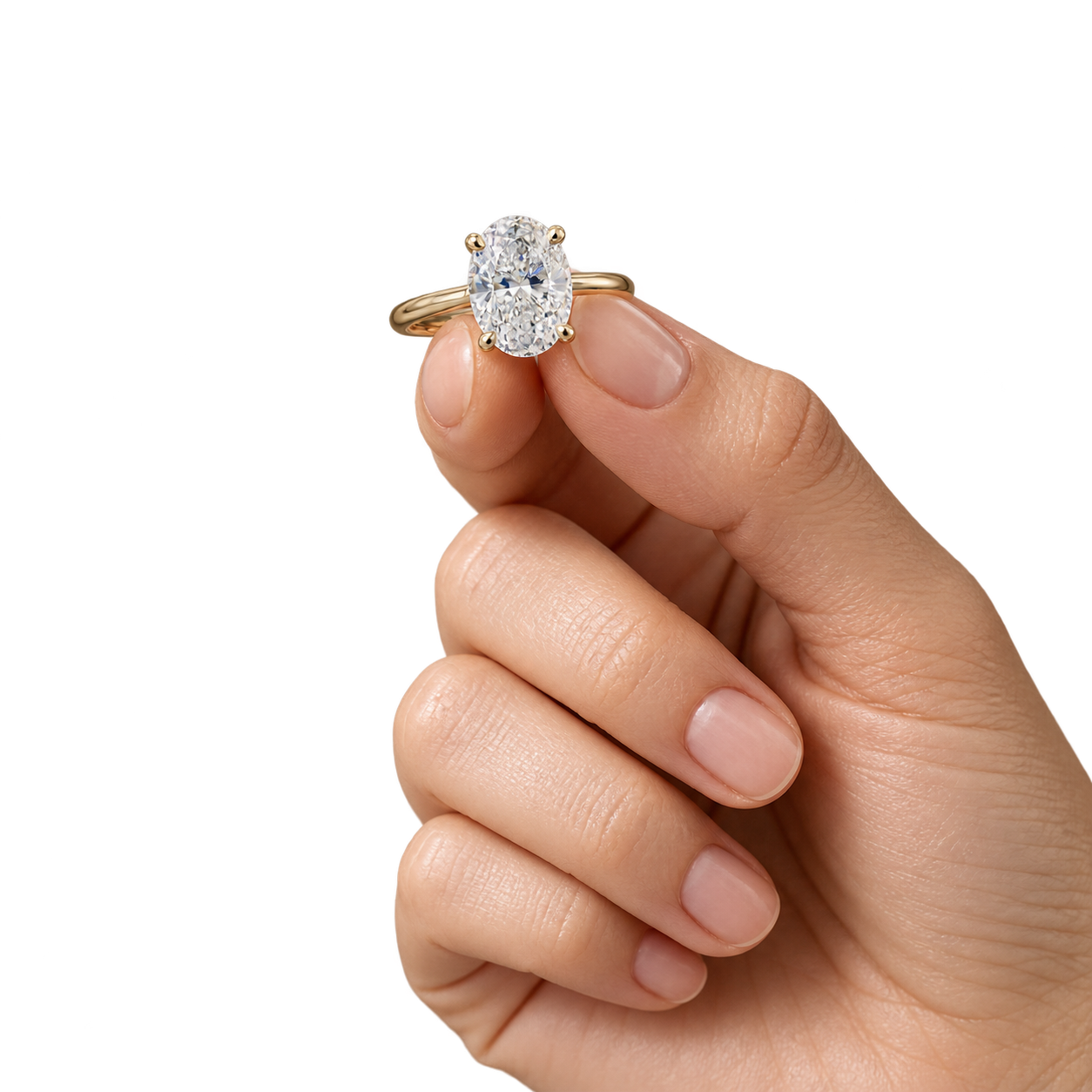
You can love every piece in your jewellery box and still feel unsure what to add next. Perhaps the earrings feel too dressy, the necklace never sits quite right, or you keep saving a favourite ring for an occasion.
I studied geology at Moscow State University and now work with stones and goldsmiths in Shenzhen. When I help someone choose a piece, I look at what they already wear, then at the stone, gold and proportions that will make the new piece easy to live with.
This guide explains those choices, from diamond shape and colour to the reason I work in 18k gold.
Ksenia
A collection of jewellery you enjoy wearing, with pieces that work beautifully together and on their own.
Your favourite earrings might be the starting point. A pendant or a diamond band can give them a different feel. Over time, you discover the combinations that feel like you.
Start by laying out what you own. Keep your favourites in view. Notice what links them: a gold colour, a rounded shape, a delicate scale. That’s the beginning of your wardrobe.
Before adding a piece, try pairing it with two favourites you already own.
Explore three combinations. Move and turn the pieces, then change the size and gold colour of the studs.
Round studs and a small round pendant share a shape without needing to be the same size. Start with these two, then see how a slim band fits alongside them.
Drag a piece to move it. Use the arrow keys on a keyboard. The other pieces stay in yellow gold so you can explore mixed metals. Illustrations show relative scale, not exact measurements.
Begin with the piece you’ll wear most often, then add another once you know what you would like beside it.
Round diamond studs are an easy starting point. Pair them with a small pendant, or let them sit quietly alongside a more noticeable ring.
Try 1 ct and 2 ct in each ear to see how much presence you like. The total weight of the pair is twice the weight of one stone.
Check the fit as well as the front view. Comfortable posts and secure backs make a difference over a long day.
A tennis bracelet adds a continuous line of diamonds around the wrist. Round studs repeat that shape and sparkle in a different proportion.
Try it alone first, then beside a slim bangle if you enjoy layering. A watch can go on the other wrist to keep the pieces from rubbing.
It should move comfortably without sliding too far down your hand. A secure clasp is part of the everyday choice.
A small stone on a fine chain is easy to pair with studs or a diamond band. Try a round pendant to echo rounded stones, or a pear shape for a different outline.
If you wear two necklaces, choose different lengths so each has space. Try a shorter plain chain with the pendant below it, and check that the chains move comfortably together.
If your favourite necklace stays in its box, a different chain length may be more useful than a new pendant.
A solitaire can be your main piece even on an ordinary day. Around 2 ct is one size to explore; the stone’s outline, setting height and fit change how it feels on your hand.
A diamond band works alone, alongside the solitaire or on another finger. Try a slim band next to a larger centre stone, with enough space that the settings don’t rub.
Pavé describes small stones set closely together. A diamond band can also use larger stones. The shape and height of both rings determine how neatly they sit together.
You can repeat a shape across your jewellery, or mix shapes through a shared gold colour. Compare how each outline looks and the kind of light it returns.
Shape illustrations, not shown to scale.
A longer outline with soft edges. A natural choice if you enjoy curved, flowing shapes.
A laboratory-grown diamond is a diamond, with the same crystal structure and essentially the same chemical, physical and optical properties as a natural one.
The difference is its origin. One forms in the earth; the other grows in a controlled laboratory environment.
Lab-grown diamonds can give you more room for the size and quality you want at a lower price than comparable natural stones. That makes them worth considering for a pair of studs, a bracelet or a ring you plan to wear often.
Choose the individual stone as carefully as the design. Its colour, cut and clarity still matter.
The scale measures how much yellow or brown body colour appears in a diamond. D begins at colourless; colour becomes gradually more visible towards Z. It does not measure sparkle, and the difference between neighbouring grades can be very subtle.
Screen colours are illustrative, not a grading reference. Diamonds are graded under controlled lighting against master stones.
Yellow and brown diamonds with more colour than Z, and diamonds that show colours such as pink or blue, are assessed separately by hue, tone and saturation.
Both are crystalline carbon. A laboratory can distinguish their origins. Natural origin has rarity and a different market price; the appearance of either depends on the individual diamond.
Moissanite is silicon carbide, with different optical properties and stronger rainbow flashes. It is durable, but it isn’t a diamond. If you love the look of diamond, compare a lab-grown stone before choosing an imitation.
CZ is a lab-made form of zirconium dioxide. It is an inexpensive diamond look-alike that scratches more easily than diamond. “Lab-created” alone doesn’t identify the material, so ask for its name.
18k gold contains 75% pure gold. That is substantially more than 14k at 58.3% or 10k at 41.7%, giving the alloy higher precious-metal content and, in yellow and rose gold, a richer colour. It is the purity I choose for ENBOM fine jewellery.
18 parts gold · 6 parts other metals
At the same weight, 18k contains more gold than 14k or 10k. Lower-karat alloys can be harder, but they contain less gold and often look paler. For me, 18k is the better balance for a fine piece: precious-metal content, depth of colour and enough alloying metal for practical jewellery.
75% gold, with other metals added for strength and colour. It has the highest gold content of these three options and a richer yellow-gold hue.
The ENBOM standard. The alloy, construction and care still determine how an individual piece wears.
Karat describes gold purity. Carat describes a stone’s weight.
Cartier specifies its gold as 750/1000. Graff and Tiffany & Co. also use 18k gold across their jewellery collections. The comparison is about gold purity; alloy recipes, design and workmanship remain individual to each piece.
Yellow, white and rose 18k gold all contain 75% gold; the other metals create the colour and affect how the alloy wears. Compare each one against your skin and beside the jewellery you already own.
Mixing metals can work, too. Repeating each colour usually makes the combination feel intentional.
A warm, rich colour. It connects a new piece to yellow-gold earrings, chains or rings you already enjoy.
Yellow and rose gold have their colour throughout the alloy. Solid 18k is resistant to tarnish, though it can still scratch and react to harsh chemicals. White gold is often rhodium-plated for a brighter finish; that surface may need refreshing.
Gold vermeil is silver with a gold layer on top. The coating can wear through. With solid 18k, the gold alloy continues throughout the piece.
18k contains 75% gold by weight. That precious-metal content has value of its own and can be recovered or remade. The finished price also includes stones and craftsmanship, so resale value differs from purchase price.
A piece that snags or feels awkward on your hand is more likely to stay in its box. Think about comfort before the design is final.
If you work with your hands, ask about lower-profile settings and smooth edges. Check how a ring feels when you bend your fingers, and how earrings sit through the day.
Hand cream and everyday oils can leave a film on diamonds. For suitable diamond-and-gold pieces, gentle cleaning with warm soapy water and a soft brush helps, especially behind the stone. Rinse carefully and dry with a soft cloth.
Take jewellery off for the gym, swimming and heavy work. Keep pieces separate in a lined box, with chains fastened to reduce tangling. Have loose stones or worn claws checked before wearing them again.
Before buying something new, ask what would make your existing pieces easier to wear. It might be studs to go with a favourite pendant, a band to sit beside your ring, or one piece you can wear on its own.
Its price will reflect the stones, the gold and the work involved. I’ll show you options and explain what changes when we adjust the design.
Follow a pendant from its first drawing through the setting and finishing on the ENBOM website.
See the making processFor an eligible centre stone, I use an IGI report for a lab-grown diamond and a GIA report for a natural diamond. The report records the stone’s identity, origin, measurements, colour, clarity and finishing.
A laboratory report belongs to the individual stone, not to the finished piece. Small accent stones are not assumed to have separate reports.
Any certificate, metal-fineness record or item documentation is separate from the diamond report. Before production, I’ll confirm exactly which documents will accompany your order for the chosen design, stones and maker.
You will know what applies to your piece before it is made.
Send me a photo of the jewellery you own or a piece you’ve been thinking about. I’ll help you compare diamonds, choose the gold and understand what changes the price.
Talk jewellery with KseniaOpens WhatsApp. You can edit the message before sending.
Did the guide make diamonds and gold easier to understand?
Say thank you to KseniaKsenia