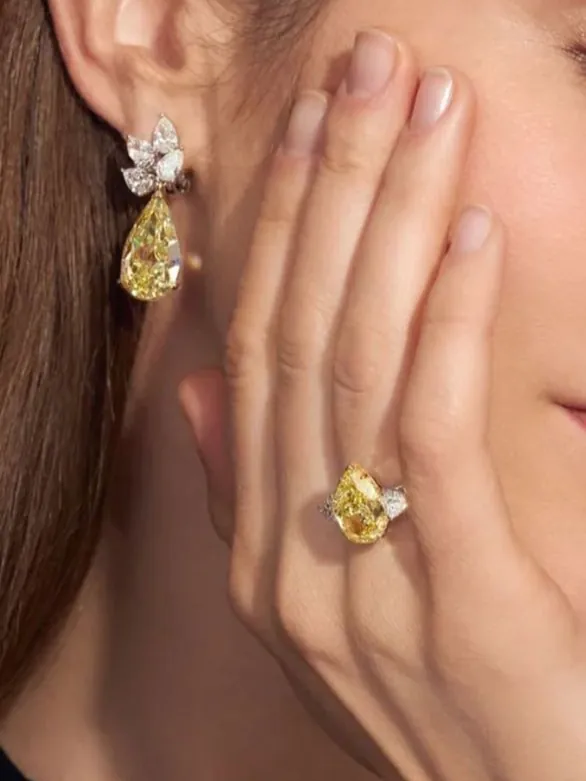
A right-hand ring has no fixed meaning: it can mark an achievement, hold a private memory or be a ring you simply want to wear. Buying yourself a diamond ring does not require a partner, a proposal or an occasion. Choose its meaning yourself, then choose the finger, fit and design for your actual life.
Does a right-hand ring say whether someone is married?
No. A ring on the right hand cannot reliably tell you whether its wearer is single, married or engaged. A woman might wear a self-purchased ring there, move an engagement ring to that hand, wear a family gift or follow a wedding custom. Sometimes there is no story beyond liking the ring.
Hand conventions change between cultures. GIA’s guide to wearing engagement and wedding rings (checked 1 October 2026) describes the left ring finger as traditional in many places and notes that wedding rings are commonly worn on the right in countries including Russia and Germany. It also describes wearing an engagement ring on the right hand as a personal option. That range makes any universal interpretation of a stranger’s ring unreliable.
If you are buying for yourself, you need not choose the right hand to send a message. You may prefer it because your other hand already holds a ring, because the design looks better there, or because you enjoy seeing it on that hand. It can mean independence if that word fits your reason. It does not have to stand for independence just because you paid for it.
What can a ring you buy yourself represent?
A self-purchased ring can mark a specific point in your life: finishing a course, changing work, recovering from a difficult year or reaching an age you had been looking forward to. You could choose a small detail that recalls it for you, such as a stone shape, an engraving or the way two bands sit together. You do not owe anyone the explanation.
It is equally reasonable to buy a ring without turning it into a milestone. Perhaps you keep returning to the same oval shape in photographs, or want one good ring to wear with what you already own. That is a complete reason to buy jewellery. Trying to give every design a symbolic meaning can distract from more useful questions: will you like looking at it, will it feel comfortable, and will you wear it?
The freedom of buying for yourself is that the recipient is present for every decision. You know whether a tall setting catches on your sleeves, whether yellow gold suits the pieces you already wear, and which finger you reach for when trying on a ring. A ring that looks impressive in a close photograph still has to work at ordinary distance, on your hand.
Which finger should you wear a self-purchased ring on?
Start with the finger you want to wear it on. The right ring finger is an obvious choice if you like the familiar position of a ring without putting it on your left hand. The middle or index finger may suit a wider band or a shape that needs more room. There is no rule assigning self-purchased rings to one finger.
Measure that finger rather than transferring a size from the opposite hand. GIA’s ring-size guide (checked 1 October 2026) explains that corresponding fingers can differ in size and recommends a jeweller’s finger gauges for the most accurate fit. Tell the jeweller which hand and finger you mean. The width of the proposed band matters too: a broad ring can feel different from a slim one at the same stated size.
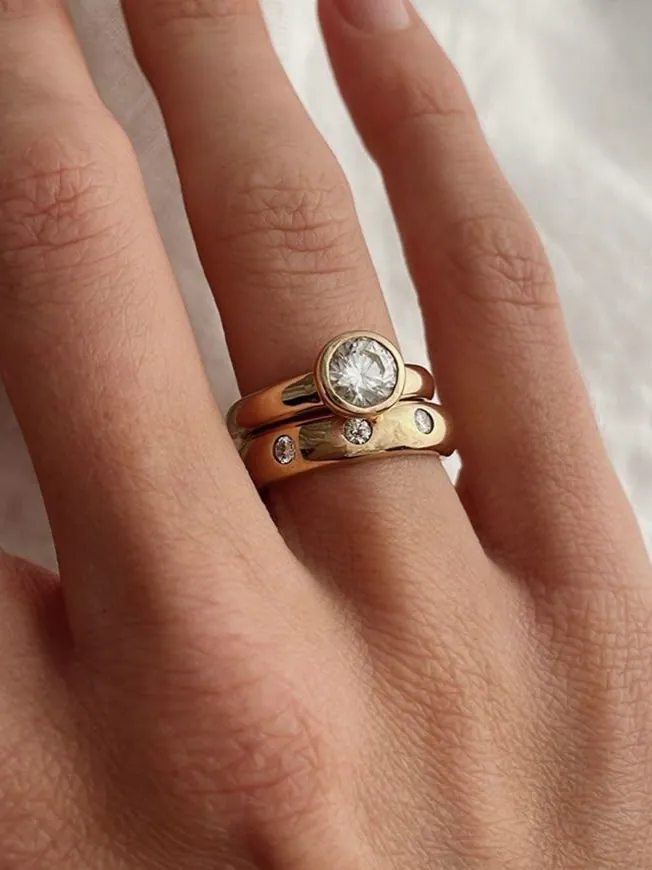
You can test the position before deciding on the design. Wear a ring of similar width on that finger for part of a normal day. Notice the feel when you type, hold a bag or put on a coat. If you wear another ring beside it, look at both from the side as well as from above. A companion band may meet the setting neatly, leave a gap or press against it; those are design choices worth seeing before you order.
Will a diamond ring I buy myself look like an engagement ring?
It might, and that is fine. A single stone on a fine band is often read as an engagement-ring style, but it is also a straightforward way to show a stone you love. People may make assumptions from its appearance. Their assumptions do not set the purpose of your ring.
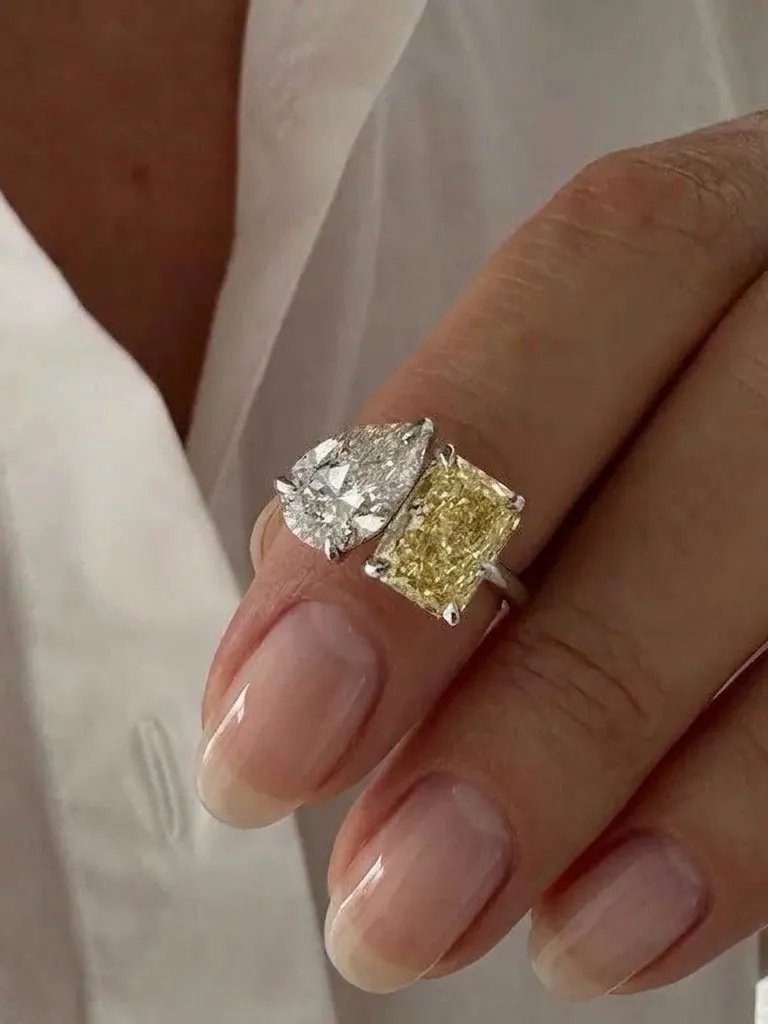
If you want a different silhouette, look at the setting before you change the stone. A round stone set into a smooth bezel feels different from the same shape lifted on prongs. A broad band changes the scale of a small centre stone. Two stones side by side create an asymmetrical line; an east–west setting turns an elongated shape across the finger. The GIA settings guide (checked 1 October 2026) explains how prongs, bezels and flush settings hold a stone and affect the ring’s profile.
Try to describe the feature you like rather than asking for a ring that is merely “not bridal”. Perhaps you want the top to sit low, a strong outline in yellow gold, or enough plain metal to balance the stone. If a saved image gets closer to your taste than those words, use it. The guide to starting a custom ring from a photo explains which details a reference can show and which still need to be chosen for your hand.
How should everyday wear change the design?
Think about what your hands do on a typical day. A raised setting gives a clear view of the stone but can catch on fabric and receive knocks. A bezel wraps metal around the edge and usually offers a smoother outline. A flush setting sits closer to the band. None makes a ring immune to wear, and their appearances differ enough that it is worth choosing with your eyes as well as your habits.
GIA’s settings guide (checked 1 October 2026) describes bezels as protective around the stone’s edge and less likely to catch on clothing or gloves. It notes that prongs show more of the stone but may catch and need checking. If you work with your hands or often wear gloves, ask to see the proposed ring from the side and discuss where its highest point will sit.
The band matters as much as the head. A very fine band can make a centre stone look prominent, while a wider one changes both the visual balance and the feel between your fingers. If you plan to wear the ring next to another, send a photo of the existing piece and its side profile. ENBOM DIAMONDS makes new pieces from a photo or idea, subject to feasibility; the design can be discussed around the ring you already wear.
Our standard metal is 18ct gold (18K, 750), with 14ct gold available on request. If you are choosing between them for a ring worn often, the 18ct versus 14ct guide covers colour, gold content and wear. Tell me whether matching another piece is important. A screen photograph alone cannot settle an exact colour match.
Should you choose a natural or lab-grown diamond?
Choose the origin you want and ask for the identity of the particular stone. A lab-grown diamond is made through a technological process; a natural diamond formed in the Earth. GIA’s explanation of the two origins (checked 1 October 2026) says they have essentially the same chemical, physical and optical properties. Their growth histories differ, and a professional laboratory can identify them.
You may prefer a natural diamond for its geological origin, or a lab-grown diamond for a particular combination of appearance and quoted price. Compare actual stones and the complete ring quotes. The word “diamond” alone does not tell you which origin is being offered, and a photograph cannot verify it.
For ENBOM DIAMONDS, lab-grown stones come with IGI reports and natural stones with GIA reports under our policy. A centre stone of 0.30 ct or more has an independent laboratory report included in the price; smaller, side and pavé stones are not individually reported. Ask which report applies to the centre stone you are considering. The IGI and GIA report guide explains what those documents describe. The planned lab-grown diamond guide will cover the broader choice of stone.
What should you compare before paying for a diamond ring?
Begin with a budget that feels comfortable to you, then compare rings you would wear. GIA’s diamond buying guide (checked 1 October 2026) sets out the four Cs: cut, colour, clarity and carat weight. They describe different properties; no single grade tells you whether a ring will look right on your hand.
Look at shape and dimensions as well as weight. Carat is a unit of weight, so two stones with the same carat number may not present the same outline or face-up size. The guide to why two 1-carat diamonds look different sizes shows what to compare. Ask for views from above and from the side. A large-looking photograph without scale is a poor substitute for measurements.
Then read the quote as a description of the whole ring. Check the stone’s origin and report, the metal, the setting, the band and what happens before production. Ask for a quote before you pay anything. At ENBOM DIAMONDS, the USD 200 design payment is the first payment towards the total quoted price; it is refundable until work on the model starts and retained once that work has been done. Three CAD revisions are included, with further revisions at USD 50 each, added to the balance invoice.
No existing ring price tells you what your own design will cost. A different centre stone, band or setting needs its own quote. If you are buying from Australia, include the complete amount you may have to pay in your comparison. With us, delivery, import duties and GST are included in the price, so you pay nothing on delivery; another seller may bill import charges separately, and this article does not calculate tax.
Where won’t this article help you?
No article can tell you what a ring on someone else’s hand means. Hand and finger conventions overlap, and personal reasons are private. If you need to know whether a specific person is engaged or married, ask them rather than reading their jewellery as a code.
This guide also cannot decide whether a particular ring will feel right once you wear it, or price a design you have not specified. Try on similar band widths, measure the intended finger and request a quote for the actual stone and setting. If the ring marks a private event, you are the person who can decide whether the design recalls it. A grading report can answer questions about a stone; it cannot choose that meaning for you.
If you have a shape, photo or even one detail in mind, see how a custom ring begins and send me your idea on WhatsApp. Tell me which finger you will wear it on and what you would like the ring to feel like. I can discuss the options and prepare a quote for a new piece.
Questions
What does a ring on a woman's right hand mean?
There is no single meaning. It may be a ring she bought for herself, a gift, a wedding ring worn according to her culture or simply a piece she likes. The hand alone cannot tell you her relationship status or why she wears it.
Can I buy myself a diamond ring without it looking like an engagement ring?
Yes. Choose the shape, setting and finger for how you want to wear it. A bezel, broad band or two-stone design can give a different look from a raised solitaire, but no design is reserved for one occasion. You can also wear a solitaire simply because you like it.
Should I size a right-hand ring using a ring from my left hand?
Measure the finger that will wear the new ring. GIA notes that corresponding fingers on the two hands can differ in size, especially when one hand is dominant. A jeweller's finger gauges are more reliable than assuming a left-hand ring will fit your right.
Is a lab-grown diamond suitable for a ring I buy myself?
Yes, if you prefer its origin and the particular stone's appearance and price. A lab-grown diamond has essentially the same chemical, physical and optical properties as a natural diamond, though its growth history differs. Ask for the stone's identity and report, and compare the complete ring quote.
Sources
- How to Wear Your Engagement Ring and Wedding Band | GIA 4Cs Checked 1 October 2026
- Ring Size Guide: Tips and Ring Size Chart | GIA 4Cs Checked 1 October 2026
- GIA Guide to Engagement Ring Settings | GIA 4Cs Checked 1 October 2026
- Is There a Difference Between Natural and Laboratory-Grown Diamonds? | GIA Checked 1 October 2026
- How to Buy a Diamond | GIA 4Cs Checked 1 October 2026